
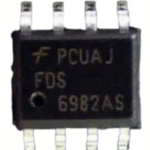


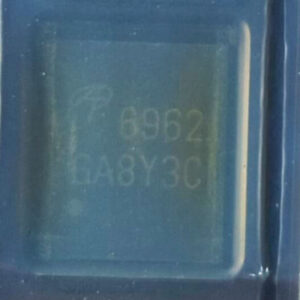
Description
 A. The value of RqJA is measured with the device mounted on 1in2 FR-4 board with 2oz. Copper, in a still air environment with TA =25°C. The Power dissipation PDSM is based on R qJA t≤ 10s and the maximum allowed junction temperature of 150°C. The value in any given application depends on the user’s specific board design.
B. The power dissipation PD is based on TJ(MAX)=150°C, using junction-to-case thermal resistance, and is more useful in setting the upper dissipation limit for cases where additional heatsinking is used.
C. Single pulse width limited by junction temperature TJ(MAX)=150°C.
D. The RqJA is the sum of the thermal impedance from junction to case RqJC and case to ambient.
E. The static characteristics in Figures 1 to 6 are obtained using <300ms pulses, duty cycle 0.5% max.
F. These curves are based on the junction-to-case thermal impedance which is measured with the device mounted to a large heatsink, assuming a maximum junction temperature of TJ(MAX)=150°C. The SOA curve provides a single pulse rating.
G. The maximum current rating is package limited.
H. These tests are performed with the device mounted on 1 in2 FR-4 board with 2oz. Copper, in a still air environment with TA=25°C.
I. For application requiring slow >1ms turn-on/turn-off, please consult AOS FAE for proper product selection.
Please Note:
-
No Returns, Exchanges, or Warranty available.
-
Kindly verify the model number and ensure it matches your product before placing an order.
-
We guarantee premium quality.
-
All items are thoroughly inspected prior to shipping.

Reviews
There are no reviews yet.